By
Olivia GarrettCorpus Christi Caller-Times
There are some books conservative activists don't want Corpus Christi students reading, and that list is growing.
They include "The Kite Runner," a bestseller about guilt and redemption set in Afghanistan, which has appeared on AP Literature tests, along with works by Nobel Prize- and Pulitzer Prize-winning author Toni Morrison and lesser-known books about race, LGBTQ relationships, bullying and mental health.
Through a series of open records requests and interviews with school districts across Corpus Christi, the
Caller-Times has obtained details on how schools are responding to a wave of book challenges.
In December, West Oso ISD received a complaint targeting three books, while this spring, Corpus Christi ISD received complaints about more than a dozen other titles at middle and high school libraries. At Flour Bluff ISD, no formal complaints have been lodged, but a handful of residents have raised the issue at school board meetings.
Behind the complaints are local chapters of national conservative organizations, County Citizens Defending Freedom and Moms for Liberty, who are calling for the removal of books that don't align with their values. They describe the books as inappropriate due to sexual content found in the challenged books, from allusions to consensual activities and examinations of sexuality and gender identity to passages focused on the trauma of sexual assault.
Texas Library Association Executive Director Shirley Robinson said that when books are removed from a library, it sends a message to students who could relate to those stories "that their experience and who they are is not valued or important."
"We know that the library is an essential part of a student's education," Robinson said. "On a school campus, the library is really the heart of that community. It's the only place in a school, and a lot of times within an entire community, where students are able to find characters just like themselves that represent their growth and development, their experience and their family circumstances."
West Oso ISD eventually did remove three books, though district staff members said in interviews that they believe in the value of the books and are concerned about the motives and consequences of book challenges.
Corpus Christi ISD has thus far opted to keep the books, noting ways that specific titles offer educational and literary value. Instead, it has marked some books with a "Mature Content" label and limited access to some books at the middle school level.
What is County Citizens Defending Freedom?
County Citizens Defending Freedom USA is a conservative organization that has been active in book challenges and assessing sexual education in schools.
A private Facebook group for CCDF's Nueces County chapter, created in September, has more than 450 members.
According to CCDF-USA nonprofit filings, the national organization's treasurer is David Bendett, who serves as pastor of Rock City Church in Corpus Christi and owner of Coffee Waves. Rock City Church, the Nueces County CCDF chapter and Coffee Waves are neighbors headquartered in the same shopping center on South Padre Island Drive in Flour Bluff.
Bendett could not be reached for comment for this story this week.
There are active CCDF chapters of the organization in Nueces County and in Hillsborough, Polk and Miami-Dade counties in Florida and future county affiliates across Texas, Florida and Georgia, according to the CCDF website.
Moms for Liberty also has county chapters across the country. Locally it has been focused on books, critical race theory and sex education.
This spring and summer, CCDF and Moms for Liberty were active in opposing a sexual education curriculum. Members spoke at local School Health Advisory Council meetings to prevent schools from introducing sexual health education programs from the Coastal Bend Wellness Foundation.
In July, the groups attended a Nueces County Commissioners Court meeting to further denounce the programs, which are available in Nueces County Public Libraries under an agreement between the county and the foundation. Youth already must have parental consent to participate.
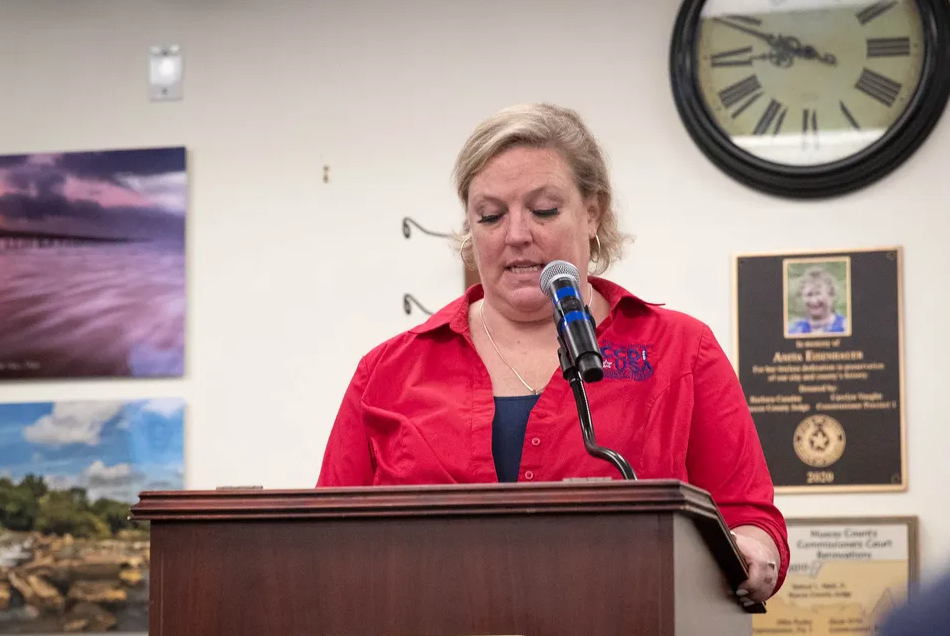
One of the CCDF members who appeared at the commissioners' meeting was Corpus Christi resident Carrie Moore, the chapter's education division leader.
Moore sent the complaints about library books to West Oso and Corpus Christi ISDs. She did not directly answer questions from the
Caller-Times about whether she has children in those school districts, instead saying in a text that she is a "concerned parent representing many parents complaining to us." She said she lives in the Corpus Christi ISD boundaries.
The 17 books challenged in Corpus Christi ISD are part of a "a nationwide effort to challenge and remove inappropriate books from school libraries across America," Moore told the
Caller-Times.
"Our team started with the most relevant books already identified by parents and concerned citizens in several school districts, including our affiliates in Florida," she wrote in an email.
Which books were targeted at West Oso ISD?
In December, West Oso ISD received an email complaining about three young adult books, a category generally meant for children 12 and up: "Out of Darkness" by Ashley Pérez, "Brave Face: A Memoir" by Shaun David Hutchinson and "The Music of What Happens" by Bill Konigsberg.
Moore, on behalf of Moms for Liberty of Corpus Christi/Nueces County, sent the email to a variety of district administrators, as well as the Texas Education Agency and several politicians.
Moore's email, included in correspondence between West Oso ISD and the TEA that the district provided to the
Caller-Times, alleges the books have "extreme sexual or racist content." "The Music of What Happens" is a young adult love story featuring two teenage boys. It includes references to sex and sexual assault but does not include descriptions of sexual acts.
"Brave Face" is a memoir focusing on the author's experiences as a young gay man struggling with depression and eventually finding self-acceptance. It includes references to sexual acts, though they are not directly narrated.
"Out of Darkness" is a historical fiction novel about love between a Black teenage boy and a Mexican American teenage girl that also focuses on racism in Texas in the 1930s. It includes depictions of consensual sex and sexual abuse, as well as scenes where a female character is objectified by racist peers.
For Superintendent Conrado Garcia, the email raised concerns about why the books were chosen. In his eyes, the complaint appeared to target books that provide diverse racial and LGBTQ representation.
"They're targeting a group of students...In my mind, that is wrong. We in education — since I started — we have always been working on the notion that we work with all children regardless of gender, regardless of sexual orientation, regardless of religious beliefs, regardless of your political beliefs."
West Oso ISD Superintendent Conrado Garcia
"They're targeting a group of students," Garcia said of Moms for Liberty. "In my mind, that is wrong. We in education — since I started — we have always been working on the notion that we work with all children regardless of gender, regardless of sexual orientation, regardless of religious beliefs, regardless of your political beliefs."
West Oso ISD initially didn't respond to the email, as Moms for Liberty had not filled out a formal reconsideration request. The district was blindsided in June, Garcia said, by an email from the TEA calling for a response to the complaint.
The TEA letter instructed the district to inform the agency within two weeks of what actions it had taken or planned to take in response to the Moms for Liberty email.
By June 20, the books were off the shelves.
"Our solution for right now was to remove the three books from our library," Garcia said. "I say that reluctantly because they (Moms for Liberty) don't represent our families. They don't represent our community. ... They didn't go through the process of our policy where we could have all sat together and reviewed the books together."
Unrelated to the book challenges, West Oso ISD brought on a new high school librarian this summer.
West Oso High School librarian Tawnya Denkeler started Aug. 1, and was not around when any of the books were added or removed from the library collection. But since coming to West Oso, she has read "Out of Darkness," which has been banned from other schools in Texas. She described it as a beautifully written and historically accurate novel.
"I'm not familiar with the current situation here because I came in late, but from my experience with this one particular book, they are taking a few phrases out of that book out of context," Denkeler said. "I truly believe that if somebody would sit down and read the book in its entirety, they would see the values of the books for our students."
Denkeler said the job of a school librarian is to provide books for every student, and that banning books suggests to students that their differences are not OK.
"If we continue to ban books, for example, about the LGBTQ community because we are not comfortable with the topic or we don't agree with the topic, we're telling our LGBTQ kids that they don't matter," Denkeler said. "If we banned books that celebrate different religious beliefs, we're telling those kids that their beliefs don't matter. And to me, every student, every child, every person matters."
School libraries are an important resource for some families, Denkeler said, particularly in a heavily low-income area such as West Oso. Those students and parents may not be able to afford buying books or have transportation to go to public libraries.
Which books were targeted at Corpus Christi ISD?
On March 4, Corpus Christi ISD received formal complaints about 17 books in middle and high school libraries across the district. Each was submitted by Moore — this time identified as a representative of County Citizens Defending Freedom.
"More Happy Than Not" by Adam Silvera
"Beloved" by Toni Morrison
"A Court of Mist and Fury" by Sarah J. Maas
"Nineteen Minutes" by Jodi Picoult
"The Kite Runner" by Khaled Hosseini
"Unravel Me" by Tahereh Mafi
"Almost Perfect" by Brian Katcher
"Extremely Loud and Incredibly Close" by Jonathan Safran Foer
"Real Live Boyfriends" by E. Lockhart
"The Bluest Eye" by Toni Morrison
"The Truth About Alice" by Jennifer Mathieu
"Dead Until Dark" by Charlaine Harris
"Dreaming in Cuban" by Cristina García
"The God of Small Things" by Arundhati Roy
"Outlander" by Diana Gabaldon
"This One Summer" by Mariko Tamaki
"Grl2grl" by Julie Anne Peters
The
Caller-Times obtained the complaints through public information requests.
Following CCISD policy, the district formed review committees to read and assess each book over the course of several months. Reports from the committees date from May through late July.
CCISD coordinator for reading and library services Cynthia Hernandez said that book challenges are rare, and that until this spring, she cannot recall anyone complaining about library books.
"In my six years, it's the first time we've ever had anyone go through both the informal and the formal request according to our board policy," Hernandez said.
The district formed two committees — one to examine books and make recommendations at the middle school level, and the other to focus on the high school level. Hernandez served on both committees.
Reached by the
Caller-Times through email, Moore said CCDF researched and read the books thoroughly.
Moore wrote that none of the books have literary value due to "the disruptive shocking nature of obscene sexual content."
"Our concern is the systematic undermining of parents and oversexualization of minors by schools that constantly devalues and degrades the communication between children and their parents, while inserting a wedge between families with shocking, misleading, and undefined concepts," Moore wrote. "The bigger concerns are the long-term mental health impact of early exposure of shocking and obscene material to minor children, while breaking their family and trust bonds."
A 2014 study, however, did not show a link between reading banned books and poor mental health in teens.
The study focused on South Texas teens who had read commonly challenged books identified by the American Library Association, such as "Huckleberry Finn" and the Harry Potter series. It found that teens who read banned books had more involvement in civics and volunteering, and that for the vast majority of participants, reading banned books was not related to poor mental health symptoms.
Each complaint from County Citizens Defending Freedom includes quoted material from the book in question and the request that it be removed from library shelves.
The book review committees did not agree to remove any books on the basis of appropriateness. Instead, they recommended a variety of measures, from taking no action to adding a "Mature Content" label or placing a book in a separate section of the library where students would need parental permission to read it. Students as young as 10 years old attend the middle school, while the young adult genre can be appropriate for the 12-18 age range, Hernandez said.
For "More Happy Than Not," a New York Times bestseller that was shortlisted in 2016 for a Lambda Literary Foundation award recognizing children's and young adult literature that explores LGBTQ themes, CCDF quoted several sentences and paragraphs that reference sexual content, though the book does not describe explicit sexual acts in detail.
But the committee reports note that the overall purpose of the book is to "show the perspective of a teenager as he deals with the suicide of his father and how he deals with his own depression."
At the middle school level, the committee recommended adding a "Mature Content" sticker and placing it in the special young adult section.
The same decision was made for copies of "Beloved," "A Court of Mist and Fury" and "The Kite Runner" in middle school libraries.
"The Kite Runner," the committee notes, is a story of friendship and atonement that sheds light on the caste system in Afghanistan and the Taliban. It includes scenes of sexual assault. "Beloved" covers the impacts of slavery in the U.S., and it includes sexual content and references to rape.
The complaint for "A Court of Mist and Fury" included quotes depicting violence and sexual content.
For these books, the committee noted that they might not be appropriate for all middle school readers, who might range in age from 10 to 14. The recommended action includes "Mature Content" stickers and parental permission.
"Nineteen Minutes" focuses on the leadup and aftermath of a school shooting. The complaint notes several passages of sexual content. According to the committee, its purpose is to understand how bullying can have tragic effects on a community and to raise awareness of mental health issues and the warning signs of abuse.
The book was in Kaffie Middle School, as well as multiple high school libraries. But, Hernandez said, the middle school's copy was in such poor condition that the district decided to remove it.
"The book was tattered and torn and barely able to be read," Hernandez said. "It needed to be weeded."
But at the high school level, the committee took different actions. Only a "Mature Content" sticker was added to "Beloved," "A Court of Mist and Fury," "Nineteen Minutes" and "The Kite Runner." No action was taken for "More Happy Than Not" at the high school level.
The remaining 11 book challenges focused on titles that only appeared in high school libraries. "Almost Perfect" includes transgender representation. "Extremely Loud and Incredibly Close," which was adapted into a PG-13 film, deals with grief after the Sept. 11 terrorist attacks. "The Bluest Eye" focuses on race and beauty standards, "The Truth About Alice" on bullying.
Many of the titles, including "The Kite Runner," "Beloved," "The Bluest Eye," "Extremely Loud and Incredibly Close," "Dreaming in Cuban" and "The God of Small Things," have appeared on AP Literature recommended reading lists.
Other books, such as "Real Live Boyfriends," "Dead Until Dark," "Outlander" and "This One Summer," aim to entertain, the committee found.
The remedy for many of the titles was to add a "Mature Content" label, though no action will be taken for titles such as "Real Live Boyfriends," "The Truth About Alice" and "This One Summer."
"A collection shouldn't be built for one reader," CCISD library media specialist Lauren Smith said. "It should be built for the community that it serves. All students need different things. Therefore, we need to have a variety available for them."
Hernandez said another book from the complaints, "Grl2grl," was not on any district shelves, as it had already been weeded from the collection at some point due to its age. That process is common in the library world, Smith said, as librarians want books that are recent and in good condition.
CCISD updates its policy
On Aug. 22, the CCISD board of trustees updated the district’s policy for instructional resources and library books. The change was essentially technical, resulting from a recommendation from the Texas Association of School Boards. The previous policy dealt with both instructional materials used in the classroom and library materials; now there is a separate policy for each.
The most notable change is a more detailed description on the selection of library materials, noting in part that collections should:Present multiple viewpoints to controversial issues in order to foster critical thinking skills.
Represent many ethnic, religious and cultural groups.
Demonstrate literary merit.
Embody the unique background of the student population.
Under the updated policy, book challenges are handled in the same manner as before.
One unchanged part of the policy notes that the ability to exercise control over materials only extends to a parent's own child and that access to a challenged material cannot be restricted during a reconsideration process unless it is requested for a specific child by their parent.
What's happening with book ban push in U.S.?
According to the American Library Association, more than 700 book challenges covering over 1,500 book titles occurred in schools last year.
Books have been challenged for as long as the printed word has been around, said Robinson, of the Texas Library Association. But the new wave of challenging books has grown more prevalent.
She characterized the movement as a political game created to divide voters at the expense of schools and libraries, depending on the efforts of a vocal minority.
The association has launched "Texans for the Right to Read," a grassroots coalition to support librarians. Robinson said some school librarians have been harassed on social media and on their campuses, making them feel unsafe and threatening their ability to do their jobs.
The majority of the titles that have been challenged across the state center on or were written by people of color or the LGBTQ community, Robinson said.
Robinson said that before resorting to formal book challenges, parents can first reach out directly to their school librarian to discuss the books their children are reading or have access to. But that isn't happening in many places.
"We're seeing a lot of libraries making the decision or being told to make the decision to pull books off the shelf just because it happens to appear on a certain list," Robinson said. "Or they are fearful for their jobs or for some type of retribution from members of the community if that book is found on shelves."
Robinson said that while it is important for parents to be involved with their children's education and what they are reading, they should not infringe on the rights of other parents.
"It's equally important for them to not interfere with what other parents' children are reading," Robinson said. "As this issue has come about, it's been very clear that it's taking away the voice of those parents who do want their children to be able to have access to these stories and these collections without their input."
What's next?
Moore told the
Caller-Times that the 17 book challenges are not the end and that CCDF is working on a new list of 21 books.
Moore said CCDF is disappointed in the Corpus Christi ISD decisions, particularly for the books where only a "Mature Content" label was added.
"How many other books are not appropriate for a middle school library and have yet to be separated and require parental permission?" Moore wrote in an email. "While parental permission is a start, why do they need to be there at all? If parents want their children to be exposed, get the books elsewhere."
Moore also wrote that CCDF aims to "have a presence" in every school district in Nueces County.
"We have amassed many volunteers already and are well on our way to meeting that goal," Moore wrote.












 If you come from Alburquerque or Guadalajara (abu-al-queq, alcornoque (cork), wadi-al-hiyara, valley of the fortress), or named Guadalupe (wadi-al-hub, river of love) or your last name is Almargo, Jara or Limon (al-magra, red land, jara, bush; laimun, tart fruit), whether you live in a village or barrio (ad-daya, estate; barri, outside), or whether you are an alguacil (sheriff) or an albañil (mason), al-wassir, minister; al-banna, (builder), or whether you prefer albondigas, meatballs, or albacora, albacore (al-bunduga, al-bakora, fish) your daily conversation will include Arab words.